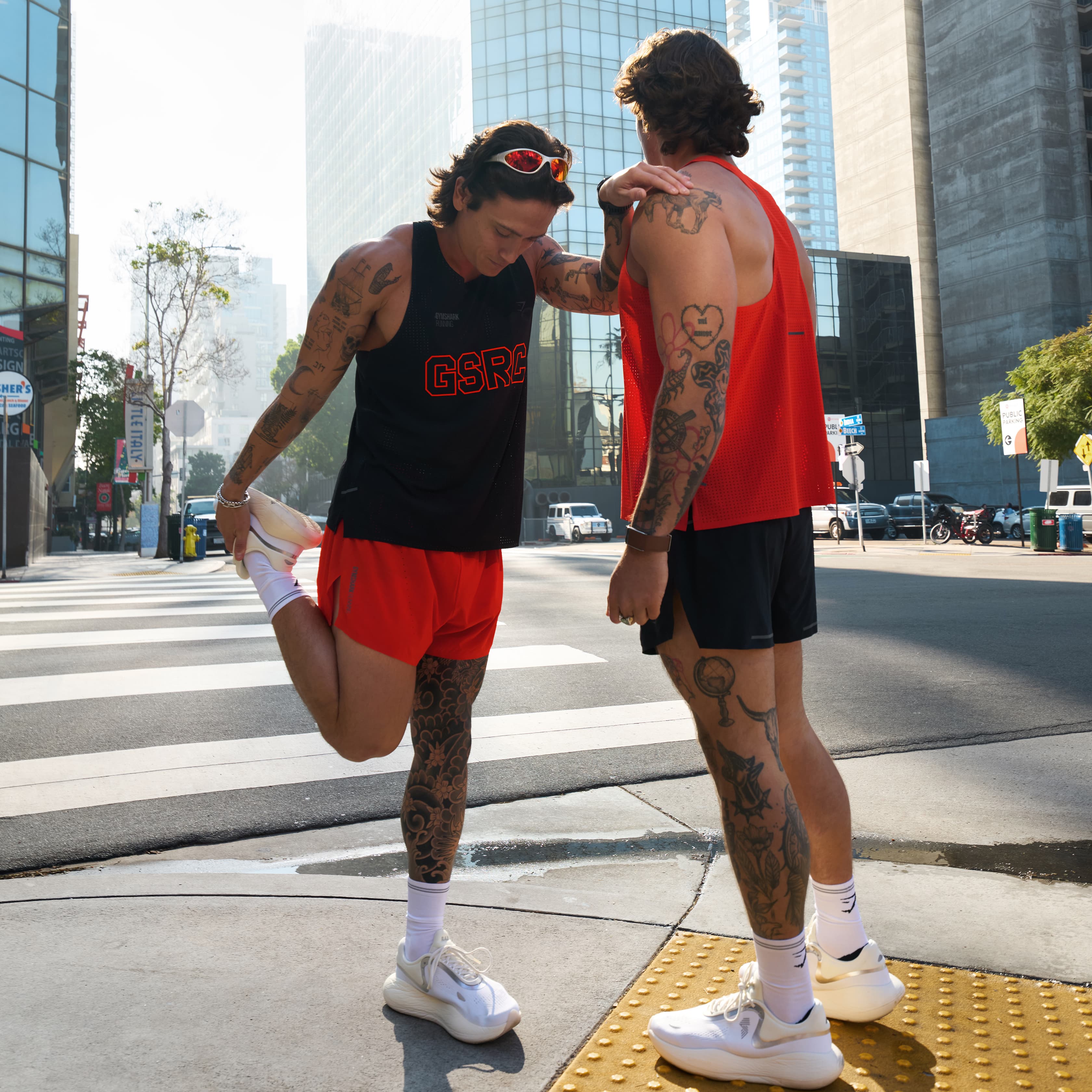



















And if you’re guilty of skipping a post-workout stretch session or two, then you’ll likely be glad to hear that it might not be as detrimental as you thought (despite what you may have seen on social media).
There are two types of stretching: Static stretching and dynamic stretching. While the latter’s popularity is on rise as a popular warm up tool that continuously moves the body through a series of stretches, static stretching is arguably the less glamorous form of stretching.
Static stretches are slow paced, time consuming, and if we’re being totally candid, can at times, be rather boring. And while some research has found static stretching can improve range of motion, reduce muscle stiffness and improve posture, there are times when using static stretching could actually be doing more harm than good.
To settle the debate, we’ve consulted BSc Sports Therapist Samantha Banks to get her thoughts on static stretching and whether we should be doing it before or after our workouts.
What Is Static Stretching?
Static stretches are positions held for a period of time to increase range of motion and flexibility [1]. Most often, they’re used post-workout, for 5 or 10 minutes as part of a cool down to stretch out the muscles and (hopefully) prevent DOMS (delayed onset muscle soreness). You’re probably no stranger to them; however, many of us are notorious for skipping them!
What Are The Benefits Of Static Stretching?
There’s lots of debate about the usefulness of static stretches, but some studies have concluded the following benefits:
Improved range of motion and flexibility: This is important not only for moving properly and with ease day-to-day but also for helping you perform exercises with the correct form [2].
Reduced muscle stiffness: Relaxing into a static stretch for a period of time encourages the muscle to relax and release tension built up from exercise. This works to reduce muscle stiffness (which, if you’re experiencing delayed onset muscle soreness or DOMS, can be a godsend!) [3].
Increased blood flow: This allows more oxygen-rich blood to reach the muscles, ensuring they get the essential nutrients needed to aid recovery [4].
Better posture: Maybe you’ve noticed a hunched posture creeping in from all those hours sat at a desk. Choosing the right static stretches to target your back can help improve posture and undo some of the effects of sitting down [5].
What Are The Drawbacks Of Static Stretches?
The timing and duration of static stretching matters: Researchers have found some drawbacks to using static stretches during warm ups:
Research has found that static stretches pose no benefit to workout performance when used during a warm up:
Research by Reid et al. found that although male participants in a 2016 study experienced an increased range of motion following four static stretches, there was no subsequent beneficial effect on strength or power performance, suggesting that including static stretches in warm-ups is pointless [6].
Other studies conclude static stretches could negatively impact maximal strength when used during warm ups:
New research conducted in 2024 concludes that while static stretches held for longer than 60 seconds during a warm-up negatively impact strength performance (but not athletic performance, as previously thought) [7].
Held for less than 60 seconds, and static stretches have been found to cause only ‘trivial negative effects’ on subsequent strength and power performances [8].
Additionally, contrary to popular belief, research has also found static stretches do not reduce injury risk (and may even increase it):
Most injuries occur far from ROM limits, therefore increasing ROM through static stretches does little to prevent injury (Thacker, Gilchrist, Stroup, & Kimsey, 2004 [9]).
Increasing ROM could actually ‘increase the range you can get injured in,’ says Samantha. Increasing the ROM that the joints move in could make them unstable and, therefore, more susceptible to injury. [10].
To reduce injury risk, Samantha suggests accompanying static stretches with ‘eccentric strengthening exercises that build strength and stability where the muscle is lengthened under tension–for example, the lowering phase of an RDL.’
When Is The Best Time To Do Static Stretches?
Taking into account the benefits and drawbacks of static stretching, when is the best time to do your static stretches? Well, again, there’s some debate regarding this:
During a separate session: Studies suggest static stretches are best done ‘independent of other training workouts’ [11]. This could be a rest day or any session separate from your workout, for example, while you’re watching TV in the evening.
Not during warm up: Leave static stretches out of the warm up, and instead stick to dynamic stretches. These are proven to improve blood circulation, increase ROM and workout performance and strength, as well as reduce chance of injury when used as part of a warm up [12, 13, 14].
‘Mobility is actually more important than flexibility. Good mobility will help you maintain strength throughout your range of motion,’ says Samantha–something that dynamic stretching is better at helping rather than static stretching.
Maybe during cooldown, but not essential: A 2021 systematic review summarizing that static stretching used post exercise may do little to help recovery [15].
‘I’m a firm believer of ‘if it makes you feel good then do it, if you don’t enjoy it, then don’t do it’’, says Samantha.
Types Of Static Stretching:
If understanding two types of stretching wasn’t enough already, static stretching can further be divided into two categories: passive stretching and active stretching:
Active Static Stretching
This type of static stretching is where you contract one muscle to stretch the opposing one, with no external force.
An example includes where you lie on your back and lift one leg straight up to the ceiling to stretch your hamstring muscle.
Passive Static Stretching
This type of stretching is where an outside force is used to assist the stretch. This could be another person, a resistance band, gravity, even your own body weight.
An example includes where you lie on your back, as above, stretching one leg up to the ceiling to stretch your hamstring muscle. Instead of holding this position as it is, you could link your hands around the back of your leg, pulling the leg in toward you to deepen the stretch. You could also place a long resistance band in the arch of your foot, pulling gently on the other end of it to pull your leg toward your body while keeping it straight to deepen the stretch.
Active Vs Passive Stretching: Which Is Better?
Passive stretching comes with a slightly higher injury risk as the ‘healthy limits of ROM can easily be surpassed by the application of external forces’ [16]. Passive static stretching was also found to increase flexibility more immediately, but improvements in ROM don’t always carry over to subsequent functional exercises and lifts performed in the gym [17].
Active static stretching, however, is better for maintaining flexibility in the long term [18]. The injury risk of active stretching is much lower, As your body won’t allow you to go beyond your flexibility range, making it a safer static stretching option.
5 Static Stretching Examples to Try:
If you are keen to do some static stretches on your rest day or as part of your cool down, here are some of our favorite active static stretches:
1. Butterfly Stretch
If you spend a lot of time sitting down, find your hips feeling tight during your workouts, or play a sport that is susceptible to groin injuries, the butterfly stretch is a good static stretch to stretch the inner thighs, groin, hips, and lower back.
How to do the butterfly stretch:
Sit on a mat. Bend your knees and take them out to the side so the soles of your feet press into each other.
Sitting tall, place your hands around your ankles and rest your elbows on your knees.
Apply gentle pressure on your knees, allowing them to fall slightly toward the ground so you feel a gentle pull and tension in your groin.
Hold for 30 seconds, release, and then repeat 3 to 5 times.
Tip: To make this static stretch more difficult, bring your feet closer to your hips.
2. Pigeon Pose
Love it or hate it, the pigeon pose is one of the best static stretches to open the hips. Targeting the hip flexors, psoas, piriformis, glutes, and hamstrings, this stretch can release tension in the hips and reduce lower back pain [19]. If you’ve been sitting for long periods of time, the pigeon pose is a good static stretch to relieve hip tightness.
How to do the pigeon pose:
Come down onto all fours. Bring your right knee in between your hands, placing it in front or in line with your hands (depending on your mobility). Move your right ankle so it is next to your left hand. Flex your toes out to the side. Your shin may be parallel to the front of your yoga mat or pointing back toward your left hip.
Straighten your left leg so it is extended behind you, with your toes pointing back.
Without rounding your back, drop your chest over your front leg, coming down onto your forearms if possible.
Hold the position for 30-60 seconds each time you take a deep breath in, leaning slightly deeper into the stretch on the exhale.
Once you are finished, press your torso up, bringing your hands back in line with your hips.
Move back onto all fours before repeating the stretch on the opposite side.
Tip: To make this stretch more difficult, place your one leg onto a high box, bending it to bring the shin parallel with the edge of the box. Place both hands on the box outside of your knee and foot, and bring your chest over your leg.
3. Lying Pectoral Stretch
While hip stretches often take much of the glory during stretch sessions, we often forget to stretch a very important muscle: The pectoral muscles or the chest muscles. This static stretch will also work to counteract any rounding posture and will relieve tightness after any presses, flies or push-ups.
How to do the lying pectoral stretch:
Lying on your front on a mat with your arms extended out to the side so your body forms a ‘T’ shape.
Bring your right hand to rest on the ground beside your chest, fingers facing forward.
Pressing into your right hand, roll your body over to your left side. Lift your right leg taking it over your left leg, bending your knee to place your right foot on the floor behind you for stability. Turn your head so it faces your right hand, ear resting on the floor.
Hold for 30 seconds, then return to the starting position and repeat on the other side.
4. Child’s Pose
This classic yoga pose (also known as ‘Balasana’) is a good static stretch to target the shoulders, back, hips, thighs, neck, and ankles. It’s a very relaxing pose, making it well suited to doing at the end of a tough workout. A 2017 study found that medical students who practiced child’s pose for five minutes a day for 90 days have improved cardiovascular measures, including lower blood pressure and resting heart rates [20].
How to do child’s pose:
Come onto all fours on a mat. Take your knees as wide as the mat, feet pointing inwards so your big toes touch.
Press your hips back, bringing the back of your hamstring to rest on your calves. As you do this, your arms should straighten to be extended in front of you (palms on the floor) as your chest drops down.
Rest your belly on your thighs and your forehead on the floor.
Hold the post for up to a minute, breathing deeply and softening into the stretch on the exhales.
5. Cobra Pose
This static stretch targets the spine, increasing mobility and strengthening the supporting muscles to help reduce back pain and that hunched-over posture from sitting at a desk for too long [20]. The cobra pose will also stretch out the serratus anterior (muscle of the chest that stabilizes the shoulder blades), rotator cuffs, abs and triceps.
How to do cobra pose:
Lying face down on a mat. Place your hands on the ground beside your chest, fingers pointing forward, elbows close to your side.
Inhale, squeeze your shoulder blades together and press through your hands to lift your chest up as you bend your back. Make sure your chest is proud, shoulders away from ears. Your thighs and feet should be kept in contact with the floor.
Hold for 30-60 seconds before lowering back down to the ground on an exhale.
Tip: Look straight ahead or slightly down during the pose to avoid straining your neck. If you feel pressure in your lower back, try moving your feet further apart.
FAQs
How Often Should You Do Static Stretches?
According to the American College of Sports Medicine’s guidelines, each major muscle group should be stretched two to three times a week, with each static stretch held for 10 to 30 seconds. This could be a combination of daily dynamic stretches during your warm up and static stretches performed on a rest day.
Is Static Stretching Bad?
Static stretching isn’t necessarily bad, but it could be if used incorrectly.
When used during a warm up, static stretching could negative impact workout performance (particularly in terms of strength). Static stretching could also increase injury risk, particularly if performing passive static stretching and pushing beyond comfortable ROM limits.
When used correctly, however, during a separate stretching session or during cool down, static stretching could improve ROM, reduce muscle stiffness, and improve posture.
Which Is Better, Static Or Dynamic Stretching?
For warming up, dynamic stretching is the preferred method, improving joint movement and muscle mobility, as well as balance and control. Research has shown that this can improve sports performance and help prevent injury [14, 11].
For cooling down, static stretches are generally preferred (however, the effectiveness of using static stretches post-workout has been questioned). For full effectiveness, static stretches are best used separately from your main workout (e.g., on a separate day or later in the day after your workout).
Does Static Stretching Help Recovery?
Research suggests static stretches only help recovery when used independently of other training sessions, not when used post-workout [11]. When used post-workout, a 2021 review found that static stretching post-workout didn’t speed up recovery [15].
However, rather than relying on static stretching to speed up recovery, you’re better off ensuring you get enough protein into your diet post-workout to aid muscle repair and glycogen replacement, along with getting enough sleep and rest between sessions. If you’re really sore, getting a sports massage or jumping in the ice bath could help, too, by reducing inflammation.
Is It Better to Do Dynamic or Static Stretches in the Morning?
It’s best not to do static stretches in the morning: ‘Stretching a cold, tight muscle could lead to injury,’ according to William Kormos at Harvard Medical School [21]. If you stretch beyond your normal range of motion during static stretches, you risk overstretching, which could lead to injury. If you want to stretch in the morning, do some dynamic stretches to improve blood flow to the muscles with less risk of injury.
All In All
The effectiveness of static stretching is a widely debated topic, with experts drawing different conclusions on its effectiveness and when it should be used (if at all).
If you are someone who enjoys static stretching and wants to include it within your routine, try to include it on a rest day or a separate session from your main workout. You can include static stretches post-workout, but research questions how much of an impact this will have. That being said, sometimes the benefits it can have for your mind to wind down and recover after a workout are totally worth it, even if they don’t necessarily help you physically!
One thing’s for sure, when warming up, leave the static stretches out of it.
So, if you’re wondering:
‘Can I do static stretches?’-Yes.
‘Do I need to do static stretches?’–Probably not.
References:
Page, P. (2012). CURRENT CONCEPTS IN MUSCLE STRETCHING FOR EXERCISE AND REHABILITATION. International Journal of Sports Physical Therapy, [online] 7(1), p.109. Available at: https://pmc.ncbi.nlm.nih.gov/articles/PMC3273886/.
Lempke, L., Wilkinson, R., Murray, C. and Stanek, J. (2018). The Effectiveness of PNF Versus Static Stretching on Increasing Hip-Flexion Range of Motion. Journal of Sport Rehabilitation, 27(3), pp.289–294. doi:https://doi.org/10.1123/jsr.2016-0098.
Nakamura, M., Ikezoe, T., Kobayashi, T., Umegaki, H., Takeno, Y., Nishishita, S. and Ichihashi, N. (2014). Acute Effects of Static Stretching on Muscle Hardness of the Medial Gastrocnemius Muscle Belly in Humans: An Ultrasonic Shear-Wave Elastography Study. Ultrasound in Medicine & Biology, 40(9), pp.1991–1997. doi:https://doi.org/10.1016/j.ultrasmedbio.2014.03.024.
Hotta, K., Behnke, B.J., Arjmandi, B., Ghosh, P., Chen, B., Brooks, R., Maraj, J.J., Elam, M.L., Maher, P., Kurien, D., Churchill, A., Sepulveda, J.L., Kabolowsky, M.B., Christou, D.D. and Muller-Delp, J.M. (2018). Daily muscle stretching enhances blood flow, endothelial function, capillarity, vascular volume and connectivity in aged skeletal muscle. The Journal of physiology, [online] 596(10), pp.1903–1917. doi:https://doi.org/10.1113/JP275459
Oba, K., Ohta, M., Mani, H., Suzuki, T., Ogasawara, K. and Samukawa, M. (2021). The Effects of Static Stretching On Dynamic Postural Control During Maximum Forward Leaning Task. Journal of Motor Behavior, pp.1–9. doi:https://doi.org/10.1080/00222895.2021.1909529.
Reid, J.C., Greene, R., Young, J.D., Hodgson, D.D., Blazevich, A.J. and Behm, D.G. (2018). The effects of different durations of static stretching within a comprehensive warm-up on voluntary and evoked contractile properties. European Journal of Applied Physiology, [online] 118(7), pp.1427–1445. doi:https://doi.org/10.1007/s00421-018-3874-3.
Warneke, K. and Lohmann, L.H. (2024). Revisiting the stretch-induced force deficit: A systematic review with multilevel meta-analysis of acute effects. Journal of sport and health science/Journal of Sport and Health Science. doi:https://doi.org/10.1016/j.jshs.2024.05.002.
Chaabene, H., Behm, D.G., Negra, Y. and Granacher, U. (2019). Acute Effects of Static Stretching on Muscle Strength and Power: An Attempt to Clarify Previous Caveats. Frontiers in Physiology, [online] 10(1468). doi:https://doi.org/10.3389/fphys.2019.01468.
THACKER, S.B., GILCHRIST, J., STROUP, D.F. and KIMSEY, C.D. (2004). The Impact of Stretching on Sports Injury Risk: A Systematic Review of the Literature. Medicine & Science in Sports & Exercise, 36(3), pp.371–378. doi:https://doi.org/10.1249/01.mss.0000117134.83018.f7.
Moscão, J.C., Vilaça-Alves, J. and Afonso, J. (2020). A review of the effects of static stretching in human mobility and strength training as a more powerful alternative: Towards a different paradigm. Motricidade, [online] 16(1), pp.18–27. doi:https://doi.org/10.6063/motricidade.20191.
Behm, D.G. and Chaouachi, A. (2011). A Review of the Acute Effects of Static and Dynamic Stretching on Performance. European Journal of Applied Physiology, [online] 111(11), pp.2633–51. doi:https://doi.org/10.1007/s00421-011-1879-2.
Hough, P.A., Ross, E.Z. and Howatson, G. (2009). Effects of Dynamic and Static Stretching on Vertical Jump Performance and Electromyographic Activity. Journal of Strength and Conditioning Research, [online] 23(2), pp.507–512. doi:https://doi.org/10.1519/jsc.0b013e31818cc65d.
Herman, S.L. and Smith, D.T. (2008). Four-Week Dynamic Stretching Warm-up Intervention Elicits Longer-Term Performance Benefits. Journal of Strength and Conditioning Research, 22(4), pp.1286–1297. doi:https://doi.org/10.1519/jsc.0b013e318173da50.
Sadigursky, D., Braid, J.A., De Lira, D.N.L., Machado, B.A.B., Carneiro, R.J.F. and Colavolpe, P.O. (2017). The FIFA 11+ Injury Prevention Program for Soccer players: a Systematic Review. BMC Sports Science, Medicine and Rehabilitation, [online] 9(1). doi:https://doi.org/10.1186/s13102-017-0083-z.
Afonso, J., Clemente, F.M., Nakamura, F.Y., Morouço, P., Sarmento, H., Inman, R.A. and Ramirez-Campillo, R. (2021). The Effectiveness of Post-exercise Stretching in Short-Term and Delayed Recovery of Strength, Range of Motion and Delayed Onset Muscle Soreness: a Systematic Review and Meta-Analysis of Randomized Controlled Trials. Frontiers in Physiology, [online] 12. doi:https://doi.org/10.3389/fphys.2021.677581.
Levangie, P.K. and Norkin, C.C. (2011). Joint Structure and Function: A Comprehensive Analysis. [online] Google Books. F.A. Davis. Available at: https://books.google.co.uk/books?hl=en&lr=&id=JXb2AAAAQBAJ&oi=fnd&pg=PR4&dq=Levangie [Accessed 7 May 2024].
Moreside, J.M. and McGill, S.M. (2013). Improvements in Hip Flexibility Do Not Transfer to Mobility in Functional Movement Patterns. Journal of Strength and Conditioning Research, 27(10), pp.2635–2643. doi:https://doi.org/10.1519/jsc.0b013e318295d521.
Nishikawa, Y., Aizawa, J., Kanemura, N., Takahashi, T., Hosomi, N., Maruyama, H., Kimura, H., Matsumoto, M. and Takayanagi, K. (2015). Immediate effect of passive and active stretching on hamstrings flexibility: a single-blinded randomized control trial. Journal of Physical Therapy Science, 27(10), pp.3167–3170. doi:https://doi.org/10.1589/jpts.27.3167.
Effectiveness of Piriformis Stretching and Intermittent Lumbar Traction along with Spinal Extension Exercises in Lumbar Disc Herniation: Comparative Study. (2021). Medico-Legal Update. doi:https://doi.org/10.37506/mlu.v21i1.2422.
K, J., B, S. and S, D. (2017). Effect of Balasana on cardiac parameters among healthy medical students. National Journal of Physiology, Pharmacy and Pharmacology, p.1. doi:https://doi.org/10.5455/njppp.2017.7.0831518082017.
Publishing, H.H. (2015). Ask the doctor: Stretching before exercise. [online] Harvard Health. Available at: https://www.health.harvard.edu/staying-healthy/ask-the-doctor-stretching-before-exercise.